Written by: VPNonix Editorial Team
Technical Review: VPNonix Research Team
Last Updated: February 2026
VPN Protocols — Bottom Line
- VPN protocols determine how your encrypted tunnel is created and maintained.
- The three most widely used protocols are WireGuard, OpenVPN, and IKEv2/IPSec.
- WireGuard is typically the fastest and most modern.
- OpenVPN has the longest security track record.
- IKEv2/IPSec is especially stable for mobile devices.
In short VPN Protocols Explained: The protocol affects speed, stability, and security — but provider implementation matters just as much as the protocol itself.
VPN Protocols Explained
VPN protocols determine how your encrypted connection is VPN Protocols Explained
VPN protocols determine how your encrypted connection is created and maintained.
In simple terms, a VPN protocol is the technology that builds the secure tunnel between your device and the VPN server. Understanding what is a VPN protocols explained in detail helps you choose the right balance of speed, security, and reliability for your needs.
The most widely used VPN protocols today are:
- WireGuard
- OpenVPN
- IKEv2/IPSec
Each offers a different combination of encryption strength, connection stability, and performance depending on your device and use case.
What Is a VPN Protocol?
A VPN protocol is a set of rules that defines:
- How data is encrypted
- How keys are exchanged
- How the secure tunnel is established
- How connection stability is maintained
Without a protocol, encryption alone would not be enough to securely transmit data across the internet.
If you’re new to VPNs, see our foundational guide:
What Is a VPN and How Does It Work?
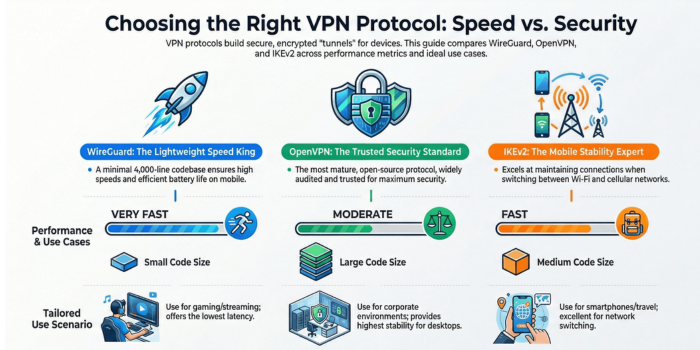
1. WireGuard Protocol Explained
WireGuard is a modern VPN protocol designed to be:
- Faster
- Simpler
- More efficient
- Easier to audit
Key Characteristics
- Uses modern cryptography (ChaCha20, Curve25519)
- Lightweight codebase (~4,000 lines)
- Fast connection establishment
- Lower battery consumption on mobile
Advantages
✔ Very high speeds
✔ Low latency (good for gaming)
✔ Efficient on mobile devices
✔ Easier security auditing
Limitations
- Originally designed without built-in anonymity rotation
- Some providers implement additional privacy layers
Best For
- Streaming
- Gaming
- Mobile devices
- High-speed connections
2. OpenVPN Protocol Explained
OpenVPN is one of the oldest and most widely trusted VPN protocols.
It is open-source and has been extensively audited.
Key Characteristics
- Uses AES-256 encryption
- Highly configurable
- Supports TCP and UDP
- Strong community support
Advantages
✔ Extremely secure
✔ Mature and stable
✔ Widely supported
✔ Proven track record
Limitations
- Slower than WireGuard in many cases
- More complex codebase
Best For
- Maximum security
- Desktop usage
- Corporate environments
3. IKEv2/IPSec Explained
IKEv2 (Internet Key Exchange version 2) combined with IPSec provides fast and stable connections.
It is particularly strong on mobile networks.
Key Characteristics
- Quick reconnection after network changes
- Built-in support on many operating systems
- Strong encryption standards
Advantages
✔ Excellent for mobile switching (Wi-Fi to LTE)
✔ Stable connection
✔ Fast reconnect
Limitations
- Closed-source implementations on some platforms
- Can be blocked by strict firewalls
Best For
- Smartphones
- Tablets
- Users frequently switching networks
WireGuard vs OpenVPN vs IKEv2 (Quick Comparison)
| Feature | WireGuard | OpenVPN | IKEv2 |
|---|---|---|---|
| Speed | Very Fast | Moderate | Fast |
| Security | Modern cryptography | AES-256 | Strong encryption |
| Code Size | Small | Large | Medium |
| Best For | Streaming, gaming | Security-focused users | Mobile devices |
| Stability | High | Very High | Excellent for mobile |
Which VPN Protocol Is the Most Secure?
All three protocols are considered secure when implemented properly.
- WireGuard uses modern cryptography.
- OpenVPN has the longest security track record.
- IKEv2/IPSec is stable and widely trusted.
Security depends not only on the protocol, but also on:
- Provider implementation
- Server infrastructure
- Logging policies
For provider comparisons, see:
(Internal link to /reviews/best-vpn-2026)
Which VPN Protocol Is the Fastest?
In most independent tests:
- WireGuard is typically the fastest.
- IKEv2 performs well on mobile.
- OpenVPN is slightly slower but highly stable.
Actual performance depends on server distance and provider optimization.
Should You Change VPN Protocol?
Most users should leave the default protocol selected by their VPN app.
Consider switching if:
- You experience speed issues
- You have connection drops
- You are on mobile networks
- A specific protocol is blocked
Common Questions
Is WireGuard safer than OpenVPN?
WireGuard uses modern cryptography and a smaller codebase, which improves auditability. OpenVPN has a longer history of real-world testing. Both are secure when implemented correctly.
Why is OpenVPN slower?
OpenVPN has a larger codebase and more overhead, which can reduce performance compared to newer protocols like WireGuard.
Is IKEv2 good for gaming?
IKEv2 can perform well, but WireGuard generally provides lower latency for gaming.
Can VPN protocols be blocked?
Yes. Some networks use deep packet inspection (DPI) to block VPN traffic. Certain protocols are easier to detect than others.
Editorial Standards
This guide references official protocol documentation and recognized encryption standards. All comparisons are based on publicly documented technical characteristics rather than marketing claims.
Sources & References
- WireGuard Official Documentation — https://www.wireguard.com/
- OpenVPN Community Documentation — https://openvpn.net/community-resources/
- IETF RFC 4301 (IPsec) — https://datatracker.ietf.org/doc/html/rfc4301
- IETF RFC 7296 (IKEv2) — https://datatracker.ietf.org/doc/html/rfc7296
Author & Review Information
VPNonix Research Team
The VPNonix editorial team specializes in VPN analysis, encryption research, and digital privacy tools. All guides follow structured testing methodology and technical verification before publication.