Written by: VPNonix Editorial Team
Technical Review: VPNonix Research Team
Last Updated: February 2026
Free VPNs – Bottom Line
- Free VPNs are not automatically unsafe — but many rely on ads, data monetization, or heavy limitations to operate.
- The biggest risk is unclear logging practices and weak infrastructure.
- Some reputable providers offer limited free tiers, but completely unknown “100% free” VPNs carry higher privacy risk.
- Free VPNs often suffer from slower speeds, overcrowded servers, and fewer security features.
- For serious privacy, banking, or long-term protection, a verified no-logs paid VPN is generally safer.
In short, Are Free VPNs Safe?: If you can’t clearly see how a free VPN makes money, your data may be part of the business model.
Why Free VPNs Raise Privacy Concerns
Free VPNs are attractive. No subscription. No commitment. Instant download.
But the real question is not whether they work — it’s whether they are safe.
This guide breaks down how free VPNs operate, the risks involved, and when (if ever) they are acceptable.
What a VPN Is Supposed to Do
A legitimate VPN should:
- Encrypt your internet traffic
- Hide your IP address
- Prevent tracking from ISPs and public Wi-Fi networks
- Protect sensitive browsing activity
To do this properly, a provider needs:
- Secure infrastructure
- Ongoing server maintenance
- Bandwidth capacity
- Security audits
- Technical support
All of that costs money.
If you are not paying for the product, the business model becomes the central concern.
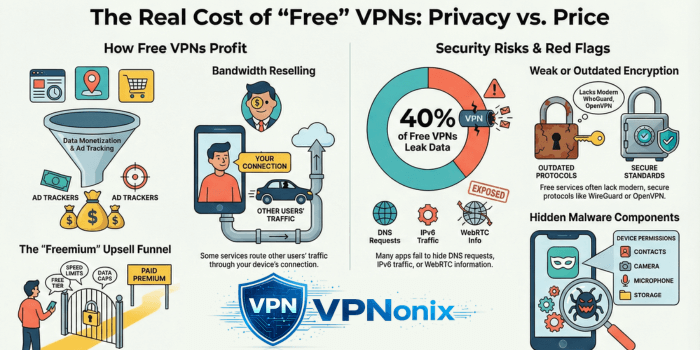
How Free VPNs Make Money
Most free VPNs rely on one or more of the following models:
1. Data Monetization
Some free VPN providers log user activity and sell anonymized (or sometimes not fully anonymized) data to third parties.
2. Ads & Tracking
Free VPN apps may inject ads or include third-party trackers inside the app.
3. Bandwidth Reselling
In extreme cases, certain services have used user devices as part of a peer-to-peer network, routing other users’ traffic through them.
4. Upsell Funnel
Some free plans are legitimate but heavily restricted. The goal is to push users into paid tiers.
Common Risks of Free VPNs
Weak or Outdated Encryption
Some free VPN services do not use modern protocols such as WireGuard or properly configured OpenVPN. If you’re unsure how these protocols differ, see our detailed guide on VPN protocols explained.
Logging Policies
“Zero-log” claims are often unverified.
Data Leaks
Poorly configured apps can leak:
- DNS requests
- IPv6 traffic
- WebRTC information
Malware or Bundled Software
Some free VPN apps have been removed from app stores for containing malicious components.
Are All Free VPNs Unsafe?
No.
There are two categories:
🔹 Reputable Providers with Free Tiers
Some established VPN companies offer limited free plans. These usually include:
- Data caps (e.g., 500MB–10GB per month)
- Limited server locations
- Reduced speeds
The free tier is used as a marketing funnel.
🔹 Completely Free Unknown Providers
These carry significantly higher risk, especially if:
- The company background is unclear
- There is no privacy policy
- The app requests excessive permissions
When a Free VPN Might Be Acceptable
A free VPN can be reasonable if:
- You only need temporary protection on public Wi-Fi
- You are testing the interface before upgrading
- You use a reputable provider with transparent policies
It is not suitable for:
- Long-term privacy protection
- Streaming geo-restricted content reliably
- Torrenting
- Handling sensitive work or financial activity
Performance Trade-Offs
Free VPNs commonly suffer from:
- Overcrowded servers
- Slower speeds
- Limited protocol support
- Inconsistent uptime
If you are comparing VPN protocols like WireGuard, OpenVPN, and IKEv2, performance depends heavily on infrastructure — something free providers rarely prioritize.
How to Evaluate a Free VPN
Before installing, verify:
- Clear ownership information
- Transparent privacy policy
- No history of data scandals
- Independent audits (if available)
- Realistic business model
If you cannot identify how the company sustains itself, assume your data is part of the equation.
The Real Question: What Is Your Privacy Worth?
Free VPNs are not automatically malicious.
However, they operate within constraints that often conflict with high-level privacy standards.
For casual use, a reputable free tier may be acceptable.
For serious privacy, secure browsing, or consistent performance — a paid VPN with verified no-logs policy and modern encryption is typically the safer option.
Final Verdict
Are free VPNs safe?
Some are. Many are not.
The difference lies in transparency, infrastructure quality, and business incentives.
If your goal is real privacy — not just the appearance of it — evaluate carefully before trusting a free provider with your traffic.
Frequently Asked Questions
Are free VPNs illegal to use?
No. In most countries, using a VPN — free or paid — is legal. However, using any VPN for illegal activity remains unlawful. Always check local regulations before relying on a VPN service.
Do free VPNs sell your data?
Some free VPN providers rely on data monetization or advertising to sustain operations. Academic research, including the study titled“ Do free VPNs sell your data? An Analysis of the Privacy and Security Risks of Android VPN Apps, found that many free VPN apps included tracking libraries.
Not all free VPNs sell data, but transparency varies significantly.
Can free VPNs leak my IP address?
Yes. Poorly configured VPN apps may leak DNS requests, IPv6 traffic, or WebRTC data. Without proper leak protection, your real IP address can still be exposed.
Are free VPNs safe for banking or sensitive work?
Generally not recommended. Free VPNs often lack advanced security infrastructure, audited no-log policies, and strong encryption enforcement. For financial transactions or work-related data, a reputable paid provider is typically safer.
Why are free VPNs slower?
Free VPN services usually limit:
- Bandwidth
- Server locations
- Available protocols
- Network priority
Overcrowded servers reduce speed and stability.
Is there any safe free VPN?
Some reputable VPN companies offer limited free tiers as part of a freemium model. These typically include data caps and restricted features but operate under the same infrastructure as their paid plans.
What is the biggest risk of using a free VPN?
The primary risk is trusting an unknown provider with all your internet traffic. If logging policies are unclear or infrastructure is weak, your browsing data may be exposed, monetized, or inadequately protected.
References – Direct Links
1) CSIRO / ICSI / UC Berkeley Study (Academic Research)
An Analysis of the Privacy and Security Risks of Android VPN Apps
https://research.csiro.au/isp/wp-content/uploads/sites/106/2016/08/paper-1.pdf
2) Norton – Are Free VPNs Safe?
https://us.norton.com/blog/privacy/are-free-vpns-safe
3) Brave – Free VPN Guide
https://brave.com/learn/free-vpn
4) Security Brief – 40% of Free VPN Apps Found to Leak Data
https://securitybrief.co.nz/story/40-of-free-vpn-apps-found-to-leak-data
5) TechRadar – Free Android VPN Issue
6) PC Gamer – FreeVPN.One Spying Report
7) Zimperium – Insecure Mobile VPNs
https://zimperium.com/blog/insecure-mobile-vpns-the-hidden-danger
8) Wikipedia – Virtual Private Network (Background)
https://en.wikipedia.org/wiki/Virtual_private_network
Author & Review Information
VPNonix Research Team
The VPNonix editorial team specializes in VPN analysis, encryption research, and digital privacy tools. All guides follow structured testing methodology and technical verification before publication.